Standard API and ASTM engine tests run on off-the-shelf motor oil, with and without SFR, plus the bench tests behind our grease, penetrating oil and diesel fuel conditioners. The numbers on this page are the laboratory's.
Product tested: SFR 100 All Purpose Oil Fortifier at the standard 5% rate
SFR passed the wear test every motor oil must pass to be certified for warranty — and did it on top of an oil that had already passed on its own.
The KA24-E runs a 2.4-litre four-cylinder engine for 100 hours of low-speed cycling — 50 minutes at 800 rpm, 10 minutes at 1,500 rpm, 200 cycles — to reproduce stop-and-go driving and long idling, the conditions the API calls "severe service." The engine is then disassembled and the camshaft lobes and rocker-arm pads are measured for wear.
Two tests were run back to back on the same test stand. The oil was the best-selling motor oil in the U.S. at the time — an API-certified 10W-30 — bought off the shelf at a retail store in Butte, Montana, so it was exactly the oil any customer could buy. The first run was that oil untreated; the second was the same oil with 5% SFR 100. Nothing else changed.
The oil that came out of both tests then went to an independent oil-analysis laboratory for particle counts and ferrography — the same kind of analysis you can run on your own equipment.
| Measurement | Untreated | 5% SFR 100 | Change |
|---|---|---|---|
| Average cam lobe wear | 41.43 µm | 35.62 µm | −14% |
| Exhaust lobe wear | — | — | −30% |
| Rocker-arm pad wear contact area | 74.5% | 61.8% | −17% |
| ISO cleanliness code of the used oil | 21/15 | 19/10 | ≈ 2× engine life* |
* Using the Life Extension Method, a published way of relating oil cleanliness to how much of its design life an engine reaches. Fewer abrasive particles circulating means less secondary wear everywhere in the engine, not just at the valve train.
| Particle size (ISO class) | Untreated (per ml) | 5% SFR 100 | Reduction |
|---|---|---|---|
| 0–5 µm | 161,890 | 143,490 | 11% |
| over 5 µm | 11,036 | 4,301 | 61% |
| over 10 µm | 1,519 | 34 | 98% |
| over 15 µm | 287 | 10 | 97% |
| over 20 µm | 90 | 5 | 94% |
| over 30 µm | 17 | 1 | 94% |
| over 40 µm | 6 | 1 | 83% |
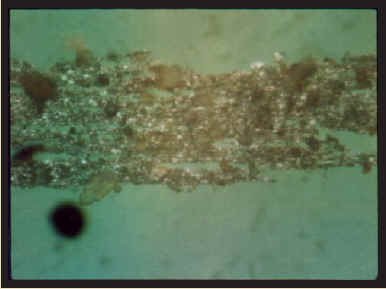
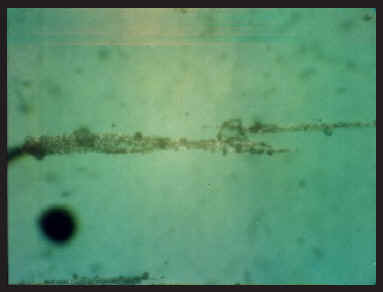
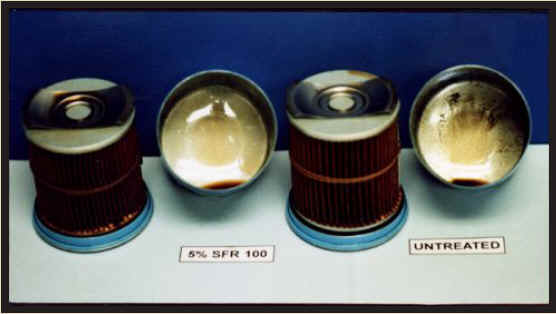
The KA24-E was chosen over the older VE test because it is several times more repeatable, and because it is the test the industry moved to for qualifying the next generation of engine oils. Running both tests back to back on one stand, with retail oil, kept every variable except SFR 100 the same.
The test is deliberately mild: no high rpm, no high oil temperature, no repeated cold starts. Those are the conditions where an extreme-pressure fortifier does its most obvious work, and none of them are in this test. The wear reductions above are the conservative case. The L-38 below covers the hot, heavy end.
Complete copies of the KA24-E report are available from SFR Corporation, 405 W. Legion, Whitehall, MT 59759, or call 800-735-6438.
Product tested: SFR 100 All Purpose Oil Fortifier at 5% in a leading API-certified 10W-40
Total bearing weight loss 21.8 mg with SFR 100, against 34.6 mg for the same oil untreated — 37% less wear, and 45% inside the 40 mg limit an oil must meet to carry the API mark.
The L-38 is the API's bearing-corrosion qualifying test. A single-cylinder test engine runs for 40 hours at 3,150 rpm with the oil held at 290 °F, on a leaded test fuel that deliberately forms corrosive compounds, with fuel contamination fed in on purpose. It uses a copper-lead bearing with no protective overlay — the most corrosion-sensitive bearing there is. An oil that passes is considered safe for API service with respect to bearing corrosion and viscosity stability.
Because the test is so severe, it answers the question customers ask most about an extreme-pressure additive: does it attack bearings? The result is the opposite. SFR 100 reduced the corrosion the certified oil was causing on its own.
| Measurement | Result |
|---|---|
| Bearing weight loss, untreated 10W-40 (the oil maker's own data) | 34.6 mg |
| Bearing weight loss, same oil + 5% SFR 100 | 21.8 mg |
| API limit for the test | 40 mg |
| Varnish rating (60 = perfect) | 59.6 |
| Sludge rating (60 = perfect) | 58.9 |
| Total Base Number, before → after 40 hours | 7.4 → 6.7 |
| Stripped viscosity at 10 hours | stayed in grade |
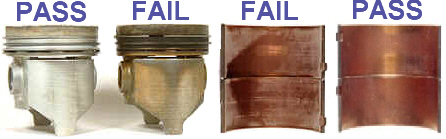
A near-perfect varnish and sludge score shows the treated oil is not building deposits under heat — an extreme-pressure package that gums up would fail here. A Total Base Number that dropped only 0.7 across the test means the oil kept almost all of its reserve against acid, which is what protects bearings between oil changes. The viscosity staying in grade after fuel contamination is stripped out shows the oil's film did not shear down.
A full copy of the L-38 report is available from sfrcorp@sfrcorp.com.
Products: the fortifier line — GASZOL, D-SOL, H-ZOL, GEARZOL, COMPREZOL, SFR 100
Motor oils generally fail the four-ball extreme-pressure test beyond 200 kg. GASZOL-treated oil carries the load to 800 kg. In D-2783 testing SFR outperformed seven leading additives on the market.
The four-ball test presses a rotating steel ball against three fixed balls in the lubricant and raises the load until the oil film breaks and the balls weld. It measures one thing: how much pressure the lubricant can carry before metal touches metal. That is exactly what happens at the valve train, lifters, push rods, valve-stem tips and rocker arms, and in gear teeth and pump vanes under load — the places that wear first.
Extreme-pressure protection is the part of an engine oil's job that most oils leave out, which is why a fortifier adds something a "better oil" does not. The engine tests above show the same chemistry does its work without corroding bearings or thickening the oil.
The same principle is what an SFR distributor shows you on a bench demonstration machine: a bearing run under increasing load in plain oil until it seizes, then in SFR-treated oil. Ask for the demonstration.
Product: SFR 2522 grease — NLGI #2, lithium complex, fortified with moly and graphite
Timken OK load over 75 lb. Dropping point 490 °F. Holds up in bearings exposed to heat, water, steam and detergents.
| Property | Method | Result |
|---|---|---|
| Dropping point | ASTM D-2265 | 490 °F |
| Penetration | ASTM D-217 | 280 |
| Base oil viscosity @ 40 °C | ASTM D-445 | 143.5 cSt |
| Base oil viscosity @ 100 °C | ASTM D-445 | 10.35 cSt |
| Viscosity @ 100 °F | ASTM D-2161 | 772 SUS |
| Viscosity @ 210 °F | ASTM D-2161 | 62 SUS |
| Pour point | ASTM D-97 | −10 °F |
| Soap type | Lithium complex | |
| Solid lubricants | Moly (molybdenum disulfide) and graphite | |
| Color | Black | |
| Weight per gallon | 7.74 lb |
A 490 °F dropping point is what lets the grease stay put in bearings and slides exposed to high temperatures — steel-mill slippers, mining and earth-moving equipment, casters on assembly lines — and the extreme-pressure package is the same technology as the fortifiers. It is fortified further with moly and graphite, solid lubricants that stay on the metal, so the grease keeps carrying load after the base grease would have squeezed out.
The grease is the product that seizes the bench-demonstration bearing on a leading synthetic and keeps running on SFR. If you want to see it, ask for a distributor near you and he will run it in front of you.
Product: SFR Lubricant & Penetrating Oil
Holds 20 weights — 600 lb and more — on the Timken test device. The leading brands hold 5 weights, 150 lb.
The machine is calibrated so that four weights dry, 120 lb, ruins the test bearing. A leading penetrating oil fails at five weights. SFR's carries the same bearing to twenty, because it is formulated with the extreme-pressure agents that loosen rusted parts by working into the surface and relieving the torque of rust — and it keeps that film strength wet or dry, after it has dried on the metal.
People expect a penetrating oil to stay wet. SFR’s is made to dry on the metal so dust and debris can’t build up on it. Put it on the bearing and race of the test machine, let it dry, and it still takes 600 lb of pressure. It is still lubricating; it just isn’t attracting dust. Re-apply it regularly, and it is the best thing you can put on exposed metal.
A black metal plate about 12 inches square, a strip of tape down the middle, the best-selling penetrating oil on one side and SFR on the other. After a month out in the open, the leading brand’s side was covered with dust. The SFR side was shiny, with almost no dust on it.
Products: D-SOL Lubricity / Cetane and D-SOL Multi-Function All Season
Injectors plugged on untreated fuel recovered 60% of their flow on D-SOL. Emissions fell as the injectors cleaned up. Fuel economy rose 2.6% on the test stand and 1.8–3.0% in working trucks.
| As the injectors cleaned up | Change |
|---|---|
| Hydrocarbons (HC) | −14.6% |
| Carbon monoxide (CO) | −6.8% |
| Particulates (PM) | −5.1% |
| Oxides of nitrogen (NOx) | −1% |
| Fuel consumption (BSFC) | −2.6% |
Three in-use Freightliners with Detroit DD60 engines: two test trucks (337,000 and 603,000 miles at the start) and a control truck. Baseline fuel-economy runs on base fuel, 15,000 miles on D-SOL-treated fuel, then the same runs again against the control.
| Truck | Fuel economy vs control |
|---|---|
| Unit 27 (337,000 mi) | +2.97% |
| Unit 28 (603,000 mi) | +1.81% |
| Test | Base fuel | + D-SOL |
|---|---|---|
| NACE rust rating | E (75–100% rust) | A (none) |
| SLBOCLE lubricity, ASTM D6078 (pass > 3,100 g) | 2,750 g | 4,550 g |
| HFRR lubricity, ASTM D6079 (pass ≤ 460 µm scar) | 570 µm | 370 µm |
| Thermal stability, ASTM D6468 (% reflectance) | 57 | 85 |
| Water tolerance, ASTM D1094 | — | no emulsion |
| Elastomer compatibility (nitrile, fluoroelastomer) | — | pass |
Download the full D-SOL test summary (PDF)
Lubricity matters because ultra-low-sulfur diesel lost the natural lubricity that protected injection pumps; the SLBOCLE and HFRR results show D-SOL puts it back to within the industry pass range. The chemistry is chlorine-free.
Current SDS for every SFR product, as PDF. Directions for use are on each product page.
Need a sheet that is not listed, or a certificate of analysis? Call 800-735-6438 or email sfrcorp@sfrcorp.com.
Laboratory tests tell you the chemistry works. Oil analysis tells you what it did in your engine: pull a sample before you treat, another at the next drain, and compare the wear metals side by side. Same independent lab, your numbers.